This may be all over Boing-Boing this morning, but it’s also (a.) genius, and (b.) deserving of any views it receives.
(via Vinay, via Boing Boing)
Jonathan Sanderson’s weblog, since 2001.
This may be all over Boing-Boing this morning, but it’s also (a.) genius, and (b.) deserving of any views it receives.
(via Vinay, via Boing Boing)
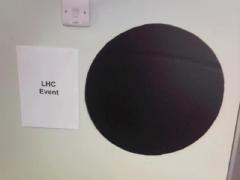
On the wall at Liverpool University Physics Department. Photo taken by Dr. Laura Grant. (sorry Laura, couldn’t resist linking to that story again. You know it’s going to haunt you)
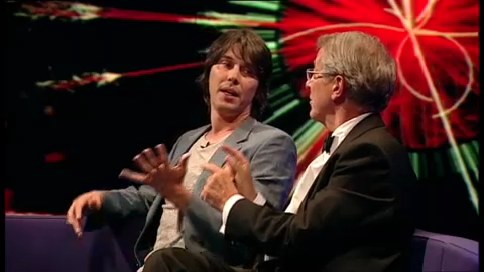
Prof Cox was on Newsnight last night, discussing the LHC with Jeremy Paxman and Sir David King – ex-Chief Scientific Advisor to the government and, currently, President of the BA.
It’s worth watching. Chris Morris has been quoted this morning as saying ‘Good face work from Brian last night,’ and he’s right. I’m not sure what function King had been to previously, but it may have dulled his senses rather. While I may be mildly sympathetic to his argument, I’m gobsmacked by the line he took and delighted Brian called him on it.
Watch it in iPlayer now: Starts about 41 minutes in.
[update: Gia’s posted the segment to YouTube.]
Via Chairman Gruber, this list of rules for happy computing is pretty good. I would, however, add one more:
Ironically, since nobody these days owns a copy of Filemaker, the main utility of this rule lies in spotting problems that are too complex/more hassle than they’re worth to complete in Excel. It’s for this reason that I keep fondling the cover of the Ruby on Rails book.
Patrick – frequenter of the comments herein and previously an Executive Producer of some of my shows – was the guy who drilled the word ‘signposting’ into my head. Almost literally, at times, in that every script review meeting we had seemed to revolve around the word, its syllables spinning around the room and boring their way into my brain. It’s probably safe to admit now, a decade on, that I usually ‘escaped’ those meetings rather than ‘concluded’ them, and that frequently I had no idea what he was talking about.
Yet here I am, writing a screed about signposting in popular science shows.
Yesterday I was at a science visitor centre which shall remain nameless, watching one of their shows. It wasn’t bad, actually, in that I quite enjoyed it, and the rest of the audience seemed to be… well, ‘rapt’ might be taking it too far, but certainly ‘interested’ and ‘engaged,’ and occasionally ‘amused.’ It was an OK little show.
But the signposting was terrible.
What that means is slightly more difficult to explain than it is to assert.
At any stage in a story, the audience should know how they got there, and why they’re there specifically rather than, say, somewhere slightly different. Nothing can be arbitrary – or at least, it can’t appear arbitrary. The moment somebody asks ‘Wait – what’s this bit about?’, they’ve broken the flow, stepped out of the traffic, lost their place on the page, and sundry related metaphors.
The standard advice on giving a presentation goes:
This is, frankly, terrible advice. It leads inexorably to interminable business presentations with heart-sinking introductions that simply scream ‘incipient repetition’ and, usually, ‘overloaded Powerpoint slides read out verbatim by some arse who thinks he’s $DEITY’s gift to marketing.’
Yeuch.
The core idea, however, is sound, though it’s perhaps better phrased as something like:
What’s often ignored is that this sort of model applies at every level of the presentation, and not merely to the overview.
Public science shows tend to be fairly loosely-linked progressions of demonstrations. Sometimes too loosely-linked to make any narrative sense, but that’s another issue. Structure is interesting because each demo – each section of the show – should fit a similar sort of scaffolding to that above. So a demo goes something like:
Demo: Make the point. Is it a reveal? Counter-intuitive? Confirmation? Validation?
What emotional response are you expecting from the audience? Should they be surprised, intrigued, smug, aghast, …? Having set up that expectation in the approach, you pay it off here.
Outro: reinforce the key thought, then link to the next section. How does what we’ve just seen advance the overall narrative? Or are we making a clean break, parking this thought to one side ahead of the next section, before re-introducing it later as part of our finale?
Either way, make the progression clear to the audience.
I get the impression that, often, writing the script of a science show involves sweating over the demos, agonising about how to set them up, and perhaps – if the writer is unusually good – ensuring a key point is made. However, I haven’t seen many shows which pay much attention to the linking thought: the segue from one demo to the next.
Yet these are key moments. If the audience’s attention is going to wander, it’s here – they’ve just seen something impressive, or encountered a big thought on which they’d like to dwell. The script has to recognise their needs, allowing them time for reflection whilst simultaneously steering their attention to the next waypoint in the overall story.
Very few shows I’ve seen in centres do this well. It’s a level of production to which they don’t, usually, aspire. But astonishingly, the bail-out alternatives – the cheapskate all-purpose links one deploys in extremis – are so well-established they’re even self-parodying:
‘Another thing that…’
‘This is like…’
‘Similarly, …’
Anything with a pun.
For a cracking – deliberate – example, see Ben Craven’s intro to the kite aerial photography demo Flossie and I did at BIG this year. It’s right at the beginning of that film.
The fact that the audience – a large crowd of professional science communicators, many of whom write shows – laughed at the dreadful segue tells us that we recognise a cliché when we hear one. Yet, we use equivalent structures – heck, precisely the same structure – routinely.
Not. Good. Enough.
If you want your audience to be amazed, you set them up for amazement; then you amaze them; then you let them be amazed; then you turn that amazement to the next point in your story. This isn’t manipulative, it’s what constructing a show is all about: leading the audience on a journey, with a clear destination, and a carefully-considered route for getting them there.
At least, this is what I’ve come to understand Patrick meant by ‘signposting.’ With a bit of luck, he’ll pop up in the comments and set me straight.

Driving East along the route of Hadrian’s Wall, chased by rain, Flossie spotted this tree. Framing the shot required some delicate clutch control on her part.
It was cold and wet: I was hardly going to get out of the car, was I?
Woah! Gorgeous WordPress theme rebuilt (with permission, yadda yadda) for Movable Type: explore it here, download from here.
Lovely. Tempting. Not sure it’s very ‘me,’ but… maybe.
Ah, newspaper magazine articles, those delightfully fluffy confections that cleanse the palette while passing unnoticed through the mind. Here’s one that’s a little more solid and stolid than most – though more because it’s discussing haggis, Lancashire hotpot, pease pudding, and clotted cream than any particular finesse of the article: ten regional specialities, and where to scoff them.
Yum.
Caution: contains strong language, graphic violence, flashing lights, and serious awesomeness.
Made by my chum Damien Wasylkiw and his brother Luke. I know, I know: somebody who used to work for me made something that’s actually good. I was surprised too. Tip o’ the hat to Gia for her tweet about this.
[update: I think that’s Damien saying ‘three… two… one… arrrgh!’. Sounds like his voice, anyway.]
[update 2: Unbelievably better than the style-free official trailer ]
[update 3, Feb 2015: as a sign of how messed-up the world is, the video was posted on MySpace. Yeah, you read that right. MySpace. It was big, back in 2008. Sheesh.]