Flip MinoHD

As the regular reader will be aware, I’m a big fan of the Flip Ultra camera, in part because its relatively large sensor offers surprisingly good performance in low light. The Flip is rarely a great video camera, but it’s a decent one in a wider range of conditions than anything else for the money. Kodak’s Zi6, for example, can produce some terrific images at much higher resolution than the Flip Ultra/Mino, but its anti-shake is lousy and its low-light performance sucks rocks.

Enter the Flip MinoHD. Andy Ihnatko has his mitts on one, the lucky git, and meanwhile there’s speculation that it might not share the Zi6’s gloomy grain problems.

Not so fast. The specs page does indeed quote better low-light sensitivity than the non-HD Mino, but those figures may not mean what one might assume. The HD has a physically smaller sensor, note, which means the individual pixels are dramatically smaller – if the ‘2.2µm’ figure is the length of a pixel’s side, they’re about one sixth the area of the previous model’s. That’s a lot less light per sensor pit.

So how can one explain the greater claimed sensitivity?

Gain. Which I’m guessing is what they mean by ‘automatic low light detection.’ No point detecting it unless you’re going to do something about it, and with just shutter speed to play with otherwise, tweaking gain is the only exposure control in hand.

Now, this may not be a bad thing. We’ve seen from Panasonic’s HMC150 that even quite high gain levels can give smooth images with H.264-derived codecs. We also know that the Flip folks have consistently made smart decisions in their software. But I’ll be waiting for the reviews before leaping for joy over this – finally, physics may not be on the Flip’s side.

Two other things to note:

  1. H.264, yay. However, this may be the final nail in the coffin of Windows Movie Maker. The lack of reliable, compatible, and up-to-date entry-level video editing tools on Windows is baffling at this point. For all the grousing about iMovie’08, it’s a wonderful tool for lashing together footage from these sorts of cameras, and for getting it on YouTube, fast.

  2. Without a microphone jack and a properly usable screen, this will still be a troublesome camera for filming things rather than people. For all its faults (notably: terrible low light performance), the Canon FS100 is still the cheapest flash media camera that’s properly versatile.
Mars Phoenix

Mars Phoenix is, most likely, gone from us. I heard it from the lander itself via Twitter – its last tweet ‘Triumph’. In binary, obviously.

If you look, right now, at what people on Twitter are saying about the mission and the lander, you’ll see fond farewells and people tearing up more than a little. Examples: 1, 2, 3.

Meanwhile, here’s a terrific interview with the writer behind the tweets.

She’s very interesting when she talks about ‘getting into character’, and the interviewer’s exactly right to suggest that the way she’s approached it is highly cinematic.

Great stuff, and absolutely my favourite STEM Engagement project of the year: quick, relatively cheap, starts discussions and conversations, personal, large audience, emotional connection… the only problem is the heavily-skewed audience. But hey, Twitter geeks deserve STEM engagement too.

Damp feet

Damp feet

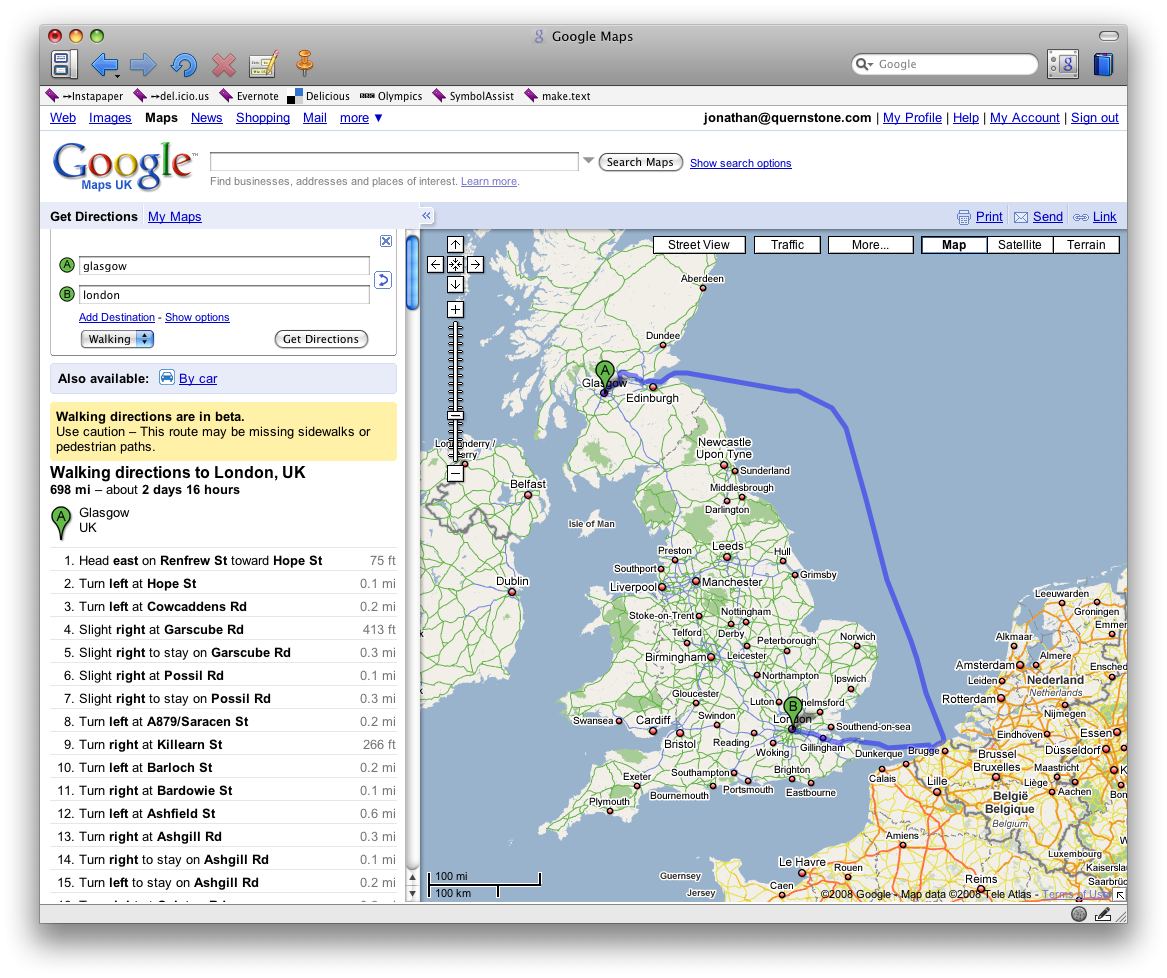
Google Maps has a new(ish) trick: directions for walking from place to place, rather than traveling by car. It’s unlikely it was intended to cover 400 mile trips between Glasgow and London, however, and the suggested route is, at first, somewhat alarming.

This reminds me of an old routing system I had on my first PowerBook, which covered all of Europe. In mere minutes it could calculate – with split-second precision for the journey time – the optimal route from Glasgow to Venice. By bicycle.

Since the average speed of a ferry is pretty good, it took ferries wherever possible, starting with Troon to Larne. It then struggled, rather, to work out how to get from Larne to Dublin without taking the motorway, and mysteriously added a loop around the perimeter of Northern Ireland before striking out to the republic. From Dublin to, I believe, Cork (a phantom ferry which I doubt exists, though I dare say one could arrange passage on a coaster if necessary), Cork to Swansea, …

Fifteen days (eight hours, thirty-seven minutes, and twelve seconds) later: Venice. Via Morocco.

MEDIA OFFLINE

There was a time, back in the day, when I thought I might end up running my own production company. I sort-of have, in a way, though not quite in the manner I might have expected. Life’s interesting like that.

Anyway, I had a name for the not-production company. It was based around a single visual gag: at the end of our productions, in that three-second slide where the company name flashes up, I was going to use a black frame with the company name emblazoned in big bold block capitals, in a pale-mid grey, with a hint of white outline and drop shadow.

The name would have been ‘Media Offline.’ And every time one of our shows went out, producers and editors right across the country would have caught a glimpse of the production caption, and in a sudden moment of panic they’d have thought, in unison, “Shit! Was that mine?”

‘Media Offline’ is a frame that Avid edit systems display when they can’t find the clip they’re supposed to play at that point. This usually means you’ve forgotten to turn a drive on, or the network’s on the fritz. But it also has an annoying habit of cropping up on a single shot in the timeline, just as you’re laying the final edit master back to tape.

But luckily, you were watching, caught it when it happened, noted the timecode, made very sure the editors saw it too, and left them to it while you wandered out for another coffee. Right?

I’ve never seen the Media Offline card actually go out on transmission, but it must have happened, and we all live in fear of it being on our show. Hence, using it as a production caption would be a very, very evil joke indeed.

I guess it’s unlikely to happen, now. But at least I can have a mousemat.

Forthcoming JVC SD-card palmcorder

I missed this news from IBC this year: JVC were showing a prototype/design study/mockup of a new very small/light SD-card camcorder. Small, that is, but still with ‘proper’ XLR audio jacks. Think ‘Sony A1 without tape’. Very interesting indeed – particularly since it’s badged ‘ProHD’, which implies MPEG2/HDV streams, not MPEG4/AVCHD.

Thread at the Panasonic discussion forums; Video segment on MacVideo.

Also interesting: JVC have licensed SxS from Sony, for their high-end cameras. So broadcasters now either go Panasonic and P2, or Sony/JVC and SxS, with a range of cameras from either.

US Election scorecard

  • Obama: 349
  • McCain: 162
  • Twitter: 538
  • BBC sound engineering: -4096

I was very conscious, as I watched the BBC’s coverage, of three things. Firstly, that I should have gone to bed after Ohio declared. Secondly, that they were having horrific problems with audio, all through the night. Barely a link was survived without echo, mysterious noises off, one-way connections, a contributor or correspondent yanking their earpiece to avoid howl, microphones not being faded up or down correctly, or a remote cue being entirely missed.

Couple the all-pervasive audio problems with some distinctly squiffy video quality (some amazingly bad chromakey, very chunky compressed stuff in places, and some footage that was plainly transmitted in the wrong aspect ratio), and you have a bad night for the BBC technical department. Something of a rout, in fact.

The dodgy technical quality was mirrored, to some extent, in shaky production values. There were some excellent, fiery and insightful studio guests, and the BBC’s correspondents were, mostly, thoroughly professional (Katty Kay and Matt Frei, take a bow). However, the new touchscreen analysis battle room set they were trying out was, frankly, ill-conceived. Let’s not mention the ghastly sound effects and touch…touch…touch dammit touch screen, let’s rather point a scornful finger at the basic problem of using such devices on TV: the presenter spends most of their time with their back to camera. Gee, thanks, that’s lovely.

Couple with Dimbleby rather bizarrely moving the show along immediately there was any sniff of interesting discussion – usually to something banal, or with no audio feed – and the whole package was, frankly, pretty shaky.

Now, for the most part it wasn’t bad as such. But the show rarely rose to the heights we expect – nay, demand – of our national broadcaster.

Which brings me to the third thing of which I was critically conscious: this was, I believe, the last election night I will experience exclusively through ‘old’ media. I’d intended to lug my laptop into the lounge, but it was busy compressing video and my broadband was on the fritz anyway. So I didn’t.

And then I started to miss Twitter, and the US political blogs.

And then I got all nostalgic. I don’t remember even thinking about following the 2004 election online – I was BBC all the way. Now, suddenly, I’ve crossed whatever mental barrier was in place, and my starting assumption is that the BBC’s coverage is just another feed to place alongside all the others.

I realised, at that point, that I’m unlikely ever to watch election results the ‘old’ way, again. So I watched as much of US’08 as I could with a slightly forlorn sense of time being marked.

If it’s possible to be nostalgic for something while it’s happening, that was my frame of mind. Hence, I rather liked the technical goofs. They were part of that package, part of that way of doing things, part of how the world used to be.

Now we have fail whales and “500 Server Error” and spam storms. They’re just not the same.