I’ve waited ten years to get a grip on how the various bits of the International Space Station (didn’t it used to be called ‘Freedom’? Ah, OK, no.) fit together. Now, for its tenth birthday, USA Today have made a lovely animation of how it’s grown.
Category: Uncategorized
Things I miss #436
I miss the canteen at Yorkshire Television.
(inspired by this)
A handy terminology key for identifying the likely sources of social media projects
Further to the previous post, I think what I’m trying to say is:
“The audience”
how old media projects from old media organisations refer to their most important constituency.
“The audience”
how new media projects from unreconstructed old media organisations refer to their most important constituency.
“Audiences”
how new media projects from old media organisations that ‘get it’ refer to their most important constituency.
“Community”
how new media projects from new media organisations refer to their most important constituency.
“Communities”
how new media projects from new media organisations that are so cutting edge they have no need for this sort of key refer to their most important constituency(/ies).
“Advertisers”
the people who are really the most important constituency for all the above, unless (media organisation) == ‘BBC’.
Find Your Tribe
FindYourTribe is an online survey that claims to work out what social grouping you’re part of. It’s a bit of a giggle. It’s from Channel 4, despite lack of appearance on the front page (roll over the thinly-grey ‘About this game’ to learn that crucial snippet).
I rather enjoyed taking the survey. It’s wittily done, doesn’t take itself too seriously, and some of the questions are unexpected and quite clever.
I also think the whole thing is massive nonsense, and not in a ‘just a bit of fun’ reasonable sort of way.
My impression is doubtless skewed by two main problems: firstly, I’m entirely the wrong age for this thing (though there is a category for ’35+’. Gee, thanks). Secondly, the three options it gave me at the end for ‘my tribe’ were all defined principally by music choice and hair style. Er… what?!
Of course, now I can’t go back and check what all the other tribes were, but I’ve a bigger problem with this: while I accept that youth culture is, to an extent, tribal, isn’t ‘tribe’ just a politically-correct synonym for ‘stereotype’?
Profiling audiences as a route to understanding them is, of course, entirely reasonable. But there’s something insidiously self-selecting about the presentation here, as if I’m supposed to funnel myself down into one of the predetermined stereotypes, or rail against the system for – OMG! OMG! Worst day of my life! – putting me in the wrong one.
Hmm.
Actually, I think what frustrates me most is that we’re seemingly stuck with blunt instrument tools like this, as we explore the intersection of centralised media and dispersed, interpersonal audiences. This feels like a tool from a previous generation. Wrapped in neat design and carefully-appropriate language choices, to be sure, but structurally the sort of thing the BBC might have done with a clipboard in 1986.
The problem with ‘the audience’ is that, to its members, it’s not ‘the audience.’ It’s ‘me, and my mates, and a bunch of people I don’t know but with whom I apparently have something vaguely in common, apart from that guy over there who’s obviously a tosser.’
And that’s only for physical groupings: for broadcast or web media, ‘the audience’ is usually, as far as I’m concerned, me. Just me.
While much of this new social media revolution might be about connecting me with people slightly like me in new and interesting ways, it’s still experienced by individuals. Lots of them. All alone. Simultaneously, but not together. To your servers they might look like ‘the audience,’ but in their heads they’re not.
Tools like FindYourTribe might be useful after all, if they help spot patterns of behaviour, broad groupings, and give a sense of the individual variation within groups. They can work as ‘pull’ models, where the media producer uses the stereotype labels as affordances to help understand audiences, and grapples with how their media might affect people within those categories.
Too often, however, the stereotypes become the targets for ‘push’ models, where one assumes the stereotype works and mercilessly tunes one’s media and its delivery to suit. That worked for broadcast TV, where the stereotypes were very broad-brush and the audience scale was immense; we have neither of those factors on our side with the sorts of things FindYourTribe is meant to inform.
Why is science important?
It’s high time I introduced the regular reader to another project of mine, namely this blog: Why is science important?
Well, I say ‘mine.’ Really I mean ‘Alom’s‘, since the project is his. I just threw together the blog. Alom’s a TV producer and physics teacher (odd combination, roll with it), making a film trying to explain to his students why science is… er… important. Funded by the Wellcome Trust, so there must be something in it.
The list of contributors so far is quite impressive, with more to come.
Join in.
Toshiba Upscaling
Having been impressed by this ‘behind the scenes’ video, I found myself a little underwhelmed by the advert itself. Partly because I found it rather hard to track down. Go to this site, click ‘explore the site’, then ‘view the ad’ in the top menu.
Damned clever, but too clever, maybe?
[Update: good links and discussion on this at Metafilter, which led me to this article about kinetic computing.]
Why the Flip isn’t the best camera ever

Following on from my previous post about the MinoHD, I happened to write this in an email for Vinay, who’s about to do some video policy work for an NGO. It might be useful more widely too:
The major limitations/trade-offs with the Flip concept are:
- No microphone jack. You have zero options for good sound, unless you count off-camera recording, clapperboards, and post-sync.
-
Fixed screen means you more-or-less have to shoot from head height. You can’t easily shoot sitting subjects, or people interacting with props. It can be done, but handling in these situations is poor.
-
Close focus is limiting; big close-ups will always be blurry.
The Flip can do what it does in part because it makes a huge assumption: that 80% of what you shoot will be somebody speaking to you or the camera. That is, a mid-shot of some sort. Most of the time, this is a reasonable guess.
But it’s not a valid assumption for demo-based filming – the story is often told by the detail of the prop you’re showing, and the Flip starts to break down here. There are good reasons people use cameras costing £500, £5,000, or £50,000, and they’re not all about raw picture quality.
Example: want to film a mosquito? With a Flip you’ve no chance. The best camera I have for this is the £225 FS100, which close-focuses down to about 1cm (which is bizarre, actually, but I’m not complaining). It captured the image you see attached to this post. You can tell it’s a female, for heaven’s sake.
Flip MinoHD
As the regular reader will be aware, I’m a big fan of the Flip Ultra camera, in part because its relatively large sensor offers surprisingly good performance in low light. The Flip is rarely a great video camera, but it’s a decent one in a wider range of conditions than anything else for the money. Kodak’s Zi6, for example, can produce some terrific images at much higher resolution than the Flip Ultra/Mino, but its anti-shake is lousy and its low-light performance sucks rocks.
Enter the Flip MinoHD. Andy Ihnatko has his mitts on one, the lucky git, and meanwhile there’s speculation that it might not share the Zi6’s gloomy grain problems.
Not so fast. The specs page does indeed quote better low-light sensitivity than the non-HD Mino, but those figures may not mean what one might assume. The HD has a physically smaller sensor, note, which means the individual pixels are dramatically smaller – if the ‘2.2µm’ figure is the length of a pixel’s side, they’re about one sixth the area of the previous model’s. That’s a lot less light per sensor pit.
So how can one explain the greater claimed sensitivity?
Gain. Which I’m guessing is what they mean by ‘automatic low light detection.’ No point detecting it unless you’re going to do something about it, and with just shutter speed to play with otherwise, tweaking gain is the only exposure control in hand.
Now, this may not be a bad thing. We’ve seen from Panasonic’s HMC150 that even quite high gain levels can give smooth images with H.264-derived codecs. We also know that the Flip folks have consistently made smart decisions in their software. But I’ll be waiting for the reviews before leaping for joy over this – finally, physics may not be on the Flip’s side.
Two other things to note:
-
H.264, yay. However, this may be the final nail in the coffin of Windows Movie Maker. The lack of reliable, compatible, and up-to-date entry-level video editing tools on Windows is baffling at this point. For all the grousing about iMovie’08, it’s a wonderful tool for lashing together footage from these sorts of cameras, and for getting it on YouTube, fast.
-
Without a microphone jack and a properly usable screen, this will still be a troublesome camera for filming things rather than people. For all its faults (notably: terrible low light performance), the Canon FS100 is still the cheapest flash media camera that’s properly versatile.
Mars Phoenix
Mars Phoenix is, most likely, gone from us. I heard it from the lander itself via Twitter – its last tweet ‘Triumph’. In binary, obviously.
If you look, right now, at what people on Twitter are saying about the mission and the lander, you’ll see fond farewells and people tearing up more than a little. Examples: 1, 2, 3.
Meanwhile, here’s a terrific interview with the writer behind the tweets.
She’s very interesting when she talks about ‘getting into character’, and the interviewer’s exactly right to suggest that the way she’s approached it is highly cinematic.
Great stuff, and absolutely my favourite STEM Engagement project of the year: quick, relatively cheap, starts discussions and conversations, personal, large audience, emotional connection… the only problem is the heavily-skewed audience. But hey, Twitter geeks deserve STEM engagement too.
Damp feet
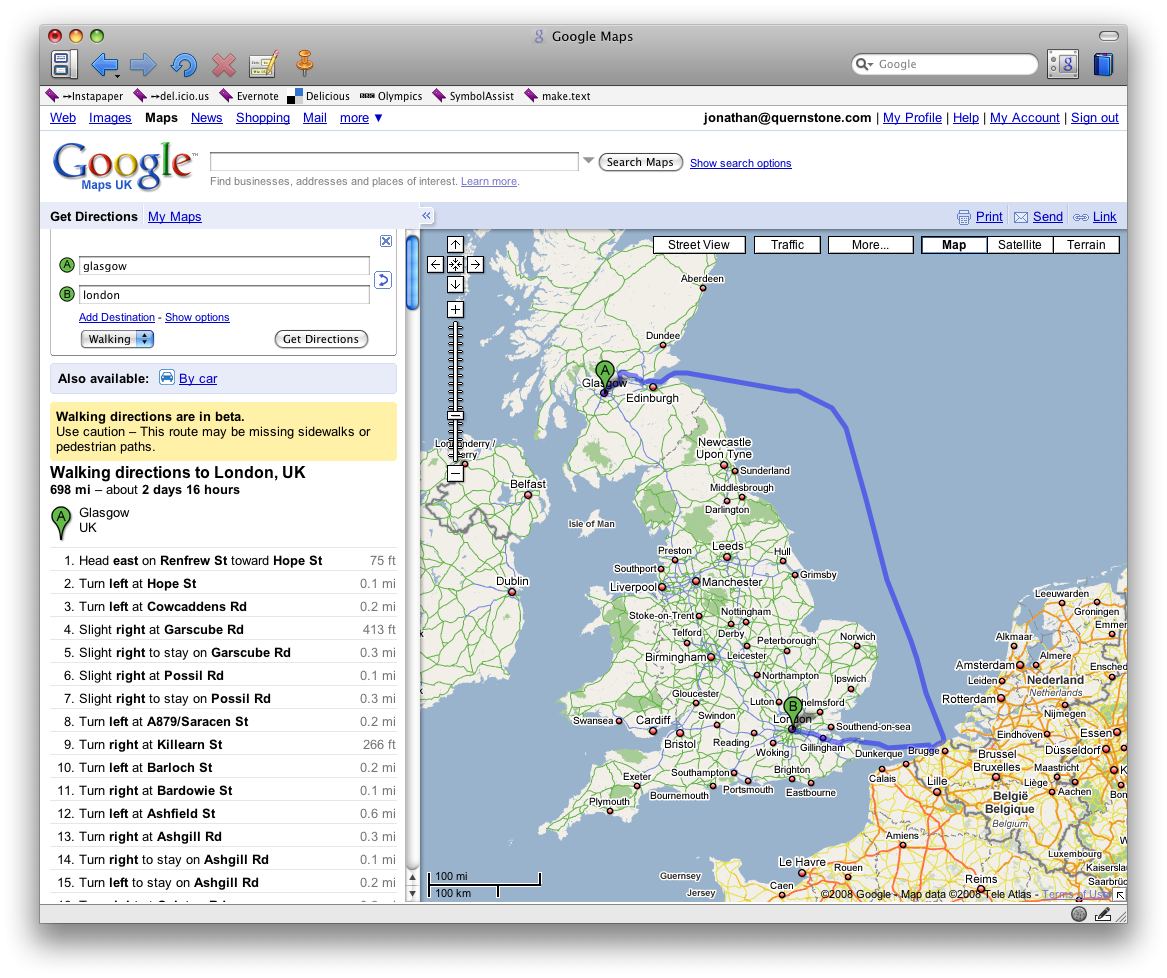
Google Maps has a new(ish) trick: directions for walking from place to place, rather than traveling by car. It’s unlikely it was intended to cover 400 mile trips between Glasgow and London, however, and the suggested route is, at first, somewhat alarming.
This reminds me of an old routing system I had on my first PowerBook, which covered all of Europe. In mere minutes it could calculate – with split-second precision for the journey time – the optimal route from Glasgow to Venice. By bicycle.
Since the average speed of a ferry is pretty good, it took ferries wherever possible, starting with Troon to Larne. It then struggled, rather, to work out how to get from Larne to Dublin without taking the motorway, and mysteriously added a loop around the perimeter of Northern Ireland before striking out to the republic. From Dublin to, I believe, Cork (a phantom ferry which I doubt exists, though I dare say one could arrange passage on a coaster if necessary), Cork to Swansea, …
Fifteen days (eight hours, thirty-seven minutes, and twelve seconds) later: Venice. Via Morocco.