Of Harry and Eric

Laithwaite's_Ball

Terrific interview with Harry White of Techniquest, about science centres and informal engagement in general. Harry’s one of the old-hand caring professionals, and it shows in his fulsome replies. There are interesting parallels between his approach to hands-on exhibits, and mine to video.

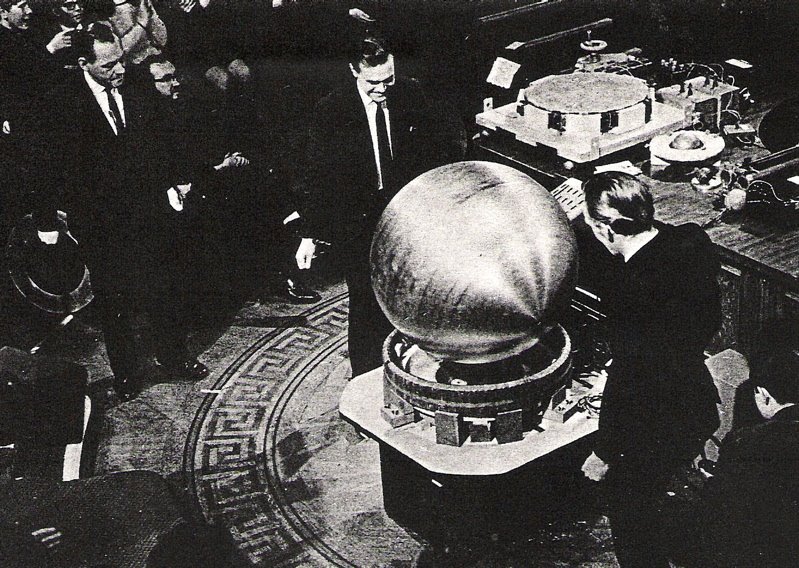
I also have a little to add about Laithwaite’s levitation demo, mentioned towards the end of the article and pictured left. The late Bill Coates, in the lower right corner of the picture, told me the story that they had, in fact, turned the thing on in rehearsals (which would have been earlier in the day, or possibly the day before recording). It worked superbly, the ball thrumming up to clear the induction coil by a good few inches, and starting to rotate gently as the eddy currents did their thing.

Witnesses were called, and a growing crowd added to the general excitement. After a period of congratulation and elation, thoughts turned to bringing the ball safely down again. This was a problem, since thoughts had not turned in this direction previously. The ball was light, but might conceivably have damaged either itself or the induction coil had the coil simply been turned off.

Also, by this time, the ball was both spinning at a considerable rate and heating up to dangerous temperatures. It was, after all, the secondary in an air-core transformer.

The eventual solution involved nothing more advanced than a bunch of BBC stagehands wearing gloves, but I still love the image of delighted physicists lurching from ‘It works!’ to ‘Oh bother!’

The ball hung for years from the rafters of the Royal Institution’s Prep Lab. I never saw the induction coil, but the ball did find other uses. Most recently, to my knowledge, I used it to cast modrock hemispheres for models of the gas giant planets and the sun for Malcolm Longair’s 1990 Christmas Lectures. At one point the ball fell off its little stand, putting a palm-sized dent in the otherwise-perfect shell. I’ve never forgiven myself.

I don’t know where the ball is now. I hope it hasn’t shared the fate of many other vintage props, of being chucked during renovation work.

(Via Paul and Flossie)

MySociety! MySociety! Rah! Rah! Rah!

Like everything else MySociety does, this rocks: crowdsourced timestamping to align captures of BBC Parliament video with the Hansard record already archived and searchable at TheyWorkForYou.com.

Genius.

I’ve matched 5 clips which at time of writing makes me the 25th most-prolific stamper today. WooT!

[thanks to Jo for the link]

[update: thanks to Ben Courtney for the link correction. Idiot operator error, apologies)

Revampsville

I’m currently hopping back-and-forth between DVDs of the original Blake’s 7 and [coughmumblecough] of the Battlestar Galactica ‘reimagining.’ It’s instructive, because in an odd way they’re rather similar shows.

OK, so Galactica’s sets wobble a whole lot less, and since most of the action is ship-bound one doesn’t notice that every inhabitable planet in the known galaxy looks uncannily like a gravel pit. Apparently. Plus there’s the whole ‘studio lighting and tube cameras ghosting like crazy’ style vs. ‘gritty hand-held high-def in extensive 360° sets’ contrast. $$$.

But both series are bleak and surprising, in contrast with the usual SF tropes of ‘idyllic futureworld’ (Star Trek) or ‘overcoming the monster’ (Star Wars). Crucially, both feature central characters whose moral alignment is both malleable, and obscured to the audience. No easy viewer proxies here: both series blur the lines between the ‘good’ and ‘bad’ guys to the extent that it’s no longer clear which is which, nor even if such simplistic concepts apply.

Blake’s 7, for all its campy space-opera façade, has always had the elements of thoroughly sophisticated drama. Paul Darrow’s Avon, in particular, may be a dreadfully vain ham but is strangely riveting nonetheless. He’s a profoundly unsympathetic character, and yet we consciously will him to make the right decisions. He makes us care about the monster, even when on the verge of doing something monstrous. Which is, of course, the central trick of Galactica: the bad-guy robots are more caring, more sympathetic, simpler characters than the good-guy humans. They’re easier to like, which only makes them creepier.

More parallels: both series suffer from cripplingly bad pacing and bizarrely uneven and clumsy script editing. Blake’s 7, in its third series (the first one without the titular character) is a wayward mess, too obviously joining the crew in being leaderless, flailing around in search of a purpose. Some good stories are severely hampered by unmotivated or inexplicable character actions, sweeping continuity leaps, and baffling aimlessness.

Similarly, I’m sorry, but some of Battlestar Galactica is plain rubbish. They consistently over-run, it seems, with the result that minutes of carefully-crafted storytelling have to hit the cutting-room floor in order to squeeze in the episode’s obligatory cliffhanger. It’s replaced with crammed exposition dubbed onto a reverse shot, or wild narrative leaps, or… unmotivated or inexplicable character actions. At times it’s so bad, it can be hard to make sense of what’s going on, or why.

The closest similarity between the shows, however, is that both series are more relevant now than they were in the late 70s. By abstracting discussions from the present-day context, both allow examination of critical ideas.

Galactica’s portrayal of the ‘good guys’ as harried, victimised, and proud-but-on-the-back-foot warriors was perfectly timed for the sheen coming off Desert Storm. The humans’ descent, via hostile occupation, into the depths of desperation and suicide bombing was breathtaking. While ‘the separation between the executive and military’ thread has never quite held together, we’ll forgive them everything for portraying the ‘bad guys’ as principled religious ascetics, and a sophisticated overall approach to the rôle of individual faith.

A reimagined Blake’s 7, if done right, would have to explore concepts of individuality, the limits of personal expression, and the boundaries within which the state must work to protect its populace. In the original series ‘The Federation’ is one-dimensionally totalitarian, drugging its subjects to maintain order and relying on ubiquitous surveillance and profiling to identify transgressors.

Our ‘heroes’ – convicted criminals, the lot of them – oscillate between self-serving pettiness, freedom fighting, and idealistic political agitation, and in the original they’re fighting an outrageously campy pantomime villain, in Servalan. This is perhaps the greatest difficulty to overcome in a reimagining, but the rewards are considerable.

Britain is presently caught between two great powers, either or both of which may be rendered irrelevant by sweeping changes further afield. Multiple generations have grown up with no concept of previous national ‘glories,’ yet the institutions and edifices of Empire still drive the country. We’re thoroughly screwed up about immigration, yet see no conflict when curry is the nation’s favourite meal. And our leaders appear fixated on blanketing cameras around the country and giving the population ID cards so they can tell everyone who they are.

Meanwhile, we have only a few standard forms of national mythology. Doctor Who has always been the Merlin of Arthurian legend, and James Bond is, pretty much, a thug given just enough room by his controllers to be useful. Which leaves Robin Hood. ‘Band of outlaw freedom fighters disrupt corrupt regime, giving hope to the common man’? Sounds familiar.

Of course, Robin Hood’s Merrie Men are hopelessly outnumbered, and their chances of anything like a stable victory are, basically, nil. Yet we celebrate them for being underdogs, for their ‘pluck’ – which is how we liked to think of ourselves in the war. Tenacity, backed up by idiosyncratic boffins. Where has all that gone?

Reimagining Blake’s 7: it’s about time we had proper discussions about the role of technology in society, the limits of personal freedom and state oversight, and the potential for wider influence by minority powers.

They’d better not screw it up.
Final Cut Express

I recently started cutting a project in Final Cut Express, on the grounds that the folks I was working with had just bought it for their 24″ iMac and they wanted to watch what I did. Fair enough.

It’s a terrific package, with basically all the timeline joy of Final Cut Pro, and you can’t argue with the price. A few things niggled, however, which I enumerate here, for reference:

  1. The two-way colour corrector. Now that the Studio package includes Color, is there really any need to deny Express users the three-way tools?

  2. Not having Soundtrack Pro is more of a bind than I expected, given that we wanted to EQ the voice track. Final Cut’s EQ tools are rubbish; Soundtrack has been a crashy mess most of the times I’ve tried to use it, but when it works it’s terrific. I’m not sure what Express users are supposed to do here. GarageBand? Struggle with per-clip multiband EQ filters? Not care?

  3. No Compressor? Really? Umm… so outputting timelines for the web is done entirely through the Quicktime dialog, or iMovie (best way to get to YouTube)? That’s… well, OK, Express is cheap, but sheesh…

  4. I wasn’t really expecting EDL import, but it’s worth noting that it’s not there. You can open Express projects directly in Pro, but I’m not sure how you go the other way. I didn’t try.

  5. Titling. Mind you, this is a common flaw with Final Cut: Boris is clunky, but the built-in tools won’t even let you choose which weight you want from an OpenType font. Typography in Final Cut is plain poor, and Express is no exception. In most cases, comp the text in Photoshop and drop the .psd on the timeline. Bleurgh.

  6. I don’t often miss multicamera support, and I certainly don’t expect it at this price. Working with DV it’s straightforward to stack the video clips in the timeline, and punch through with the razor blade to make (adjustable) cuts. In a strange way I almost prefer working like this – it makes slipping shots to cover audio edits a matter of selecting and option-arrowing, which is neat.

Final Cut Express is a thoroughly sound package. Terrific for the price, and I actually prefer the log and capture window in Express (it’s quite similar to the Log & Transfer window in Pro). However, I look forward to:

  • Soundtrack and Logic merging in the Studio packages so Soundtrack can migrate to Express, or Garageband finding some FCE integration so it can be used for final mixing.

  • Better colour controls, once Color is properly integrated with Studio.

  • Compressor. It’s slow and I’ve never seen the network rendering actually work, but why leave it out?

HDV workflow hell

I did a shoot on Thursday for which the client was happy to spring for camera hire, so we ended up shooting with a hired Sony Z1 and my friend Simon’s Canon XH A1. The latter is a lovely piece of kit – it handles brilliantly, the picture quality rocks, and it’s astonishing value. They’re going for about £2,200 at the moment, which is roughly what the hire shop is asking for the beaten-up Z1 they supplied. Easy choice.

We shot HDV, since we thought we might as well, and also because I wanted to gain a little experience with HDV workflows before I wade into the murky world of (probably) buying a camera myself later in the year. The Z1 had to go back, of course, but Simon kindly loaned me the A1 as a capture deck for the weekend. He’s in Maidstone shooting Trisha anyway, poor chap.

…and it’s at capture that my woes begin. I’d hoped to transcode at capture time from HDV to Apple’s Intermediate Codec, but it turns out that this doesn’t work with Canon’s Firewire implementation. There’s no option, in fact, but to set the device control to ‘HDV Firewire Basic,’ and import raw HDV.

This works about 25% of the time. Seriously. Forget trying to log and capture selectively – one’s only hope, it seems, is to batch-capture the entire tape and rely on HDV scene detection. Even then, changing tapes causes the A1 to simply stop sending pictures on most occasions, leading to a turn off/unplug/replug/turn on/unplug/replug/log out/unplug/reboot nightmare before a picture pops up in the log and capture window again. It’s a joke, frankly. If anything, the A1 is less stable with the tapes it shot than it is with the footage from the Z1, but it’s a disaster either way.

Happily, I’ve managed to coax the last HDV tape in, and the remainder are B-roll DV or DVCAM shots from wide-angle lock-offs. They should come in smoothly enough.

Next up: working out whether to edit HDV native, or take Final Cut up on its offer of editing HDV but rendering to ProRes 422. This is probably a good idea, at least going by this excellent summary/advice article.

Canon XH A1: terrific camera, utterly let down by its Firewire performance. If I had an external (Sony?) HDV capture deck I’d be sorely tempted, but I’m not in that sort of league. Roll on the HMC150: if Panasonic don’t naff it up, I don’t think I’ll be alone in bypassing HDV entirely and going jumping straight in AVCHD SDHC. The only real question is: how long does it take to transcode 21/24Mbps AVCHD to ProRes 422?

Some tests may be in order…

10.5.3

No, I haven’t installed it yet (since Final Cut is working at the moment, I’m going to wait a few days… never be the first to upgrade a production system). However, this caught my eye from the release notes:

Resolves an issue in which switching to a different space and returning back to the original space may reorder the application windows with a different active window.

Sounds like Spaces might actually be usable now. Yay.

Keep an eye on MacFixit over the next few days. Bearing in mind, of course, that MacFixit seemed to be inhabited by people with the sickliest Macs known to the web, and ‘Dooom! Dooooooommm!’ is their default experience of software updates.