The habitual test post

It’s a basic rule of hosting your own blog that, following a software update, one has to publish a test post.

Thus: MT4.32 (with – ugh – the Zemanta plugin. At least for the moment). It’s been a bit of a nightmare so far, but only because I’ve also updated all my plugins and tried to roll out a new version of the template too. Lots of new things… including (but not limited to) non-working comments. Perhaps.

Or maybe they do work.

We’ll see.

Modern Warfare 2

Call of Duty 4:Modern Warfare is one of those shooting-people-in-the-head games I find more than vaguely distasteful, but for reasons that subsequently escape me some time ago I bought a copy. And I played it. And I… er… enjoyed it.

Not the shooting-people-in-the-head parts, however. No, those parts make me feel ill. As do the moving-around parts – I’m a bit of a wuss when it comes to motion sickness in these sorts of games. No, the bits I enjoyed revolved around the clear sense of video games coming of age, of establishing themselves as a solid, narrative-based entertainment medium, even an art form. Elite may have rocked in its day, but it’s amoeboid compared with Modern Warfare‘s highly-evolved and sophisticated approach. COD4 wasn’t the turning point of that particular story, but for a while there it was viewed as one of the more sophisticated, ambitious, and successful games. Yes, I bought it for research purposes. Honest.

What’s interesting about the sequel, the imaginatively-titled Modern Warfare 2, is that a year or so on this progression of the whole sector seems to be regarded as much more credible. True, many stories about MW2 have focussed on its sales records, or the furore surrounding an early scene in which the player shoots civilians (sort-of. Turns out it’s more complex than that, obviously).

However, reviews like that at Eurogamer are fascinating for their rhetoric as much as what they have to say about the game directly. This is erudite, thoughtful, insightful journalism, of the sort one might expect to be reserved for arts or film reviews.

Which is, of course, entirely fitting. MW2 appears to be one of those big dumb action movies that, curiously, isn’t as dumb as you’d expected when you walked in the cinema. It’s having to appeal to the lowest common denominator to make back its production costs, but that doesn’t prevent it from striving towards a higher ideal. And if that isn’t a sign of an established, mature, and creatively fulfilling sector, then I don’t know what is.

I still don’t think I’d like it, but I’d probably run out and buy a copy if I wasn’t already immersed in Dragon Age: Origins.

Wolfram and iPhone revisited

I had cause to check my site referral stats recently, and noticed that the most common search term leading people here is no longer ‘ugly wedding dress’, as it was for many years (don’t ask). It’s now ‘Mathematica iPhone.’ No, really, The Daily Grind is the top hit for a Google search for those words. The post I wrote, more than a year ago, is here. It’s a rather lame joke.

Lame enough that I’d forgotten all about it, even when Wolfram last week published an Alpha app in the App Store: stories here and here.

Now, Wolfram Alpha quite likely offers us a glimpse into the future of Google Wave: huge anticipation; lots of geek excitement; soon revealed as being a pointless distraction that doesn’t really work right; check back in a year or so and see what it’s up to then, just in case.

Extrapolating from that parallel, let’s try again:

I hear on the grapevine that Google are working on a dedicated iPhone Wave client. Expect it in the App Store in about three months’ time, for an outrageous asking price north of £30.

[source: entirely made up.]

Gradual engagement

I’ve somehow been sucked back into web design and development of late, most of which isn’t making me happy (IE6, just die already!), but a few neat bits of tech have delighted my inner geek, and it’s also given me cause to read a few interesting articles. This, at Beta Blog, is worth a skim: Kill Your Signup Form with Rails.

Ignore the Rails part if you’re not that way inclined, the lesson here is about gradual engagement. This is something we do in education or informal engagement – wearing one of my other hats as a science communicator it’s entirely familiar – but making the connection to web development surprised me more than it should.

The idea is simple: don’t make people commit, or sign up to your site, until you absolutely have to. Amazon is a familiar example of this sort of design pattern, in that you can browse away merrily, the site identifies you via a cookie and personalises to some extent, but you don’t actually sign in until you request an action that changes state – adding an item to your wishlist, or checking out your basket, for example.

By that time you’ve already expressed an intent to provide information to Amazon, so the cost/benefit of typing your password is clear.

It’s a sound principle.

On Dublin, briefly.

It’s a couple of years since I was last in Ireland, and that a fleeting visit for the Scope wrap party, driving down from the North where I’d been giving SciCast workshops. This weekend, I flew into Dublin, was whisked to Waterford in the South-East, gave a couple of talks/workshops for the Institute of Physics, and was returned to Dublin.

Odd, the things one notices.

  • I’ve completely lost my muscle memory for Euro coins and notes. I have to peer at the loose change, reading each coin to decipher its value. Ridiculous.
  • Dublin Airport’s new terminal is impressive, though the walk from it to arrivals seems to be deliberately three times as long as necessary. I’ve never understood how it came to be that when one flies, one spends more time walking than flying.
  • On the drive back from Waterford, we passed two beautifully-preserved ruined abbeys, and a traction engine rally. The latter all steam and smoke and clanking metal, about to head off up the main road. I’d have liked to see them move, but getting stuck behind them as traffic would have delighted me less at the time.
  • Tourist offices should provide a service thus: you pay a modest fee to be followed by one of their staff, who poses as a more amateur tourist than you are. At some juncture they contrive to approach you and ask for directions to somewhere they’re absolutely certain you’ve been. Being able to give directions in a foreign city is a real buzz. Perhaps that’s just me?
  • Gruel on Dame street is still fabulous. Not as good value as it was, thanks to the now-crippling exchange rate (£:€ is basically parity, ±10%). I had a salad of feta, fine beans and roasted squash that was outrageously good, followed by terrific grilled mackerel with a new potato and broad bean salad. Simple, perfectly prepared, jaunty service – superb.
  • Lisbon vote, round two: from every lamp-post has sprouted an inelegant spray of billboards. ‘NO to European militarisation’ / ‘ YES to jobs’ / ‘Irish Democracy, 1945-2009? Vote NO’ / ‘I’ve decided: We belong: vote YES’. The impression I get is that (a.) it’s been a nasty, nasty campaign, but (b.) it’ll go through comfortably. We’ll see.
  • Ireland is still deliriously, happily, indulgently shabby chic. Nobody shows up on time, nothing quite works correctly, hotels are a little flabby around the edges, and nobody would have it any other way. Me included.

I love this place. To me, it’s like somebody made an independent state out of Yorkshire. In an odd way, I feel at home here.

International Space Station over Tynemouth

International Space Station over Tynemouth

Last week, the International Space Station made some terrific passes over the UK. I took this on Tuesday from the beach at the end of our street – it’s a terrible photo of an amazing sight.

A couple of nights later, in Cardiff Bay, I skipped away from the table of the café I was sitting outside, to catch another glimpse. The waitress thought I was a bit weird, but reckoned my excuse was sufficiently implausible that it had to be true.

The Cardiff pass was even brighter, and directly overhead. I stood with my friend Wendy and her son Oakley, the three of us gaping in astonishment (well, two in astonishment, one drooling gently). A passer-by back-tracked to ask us, “What is that? You look like you were expecting it.”

We showed him the print-out from Heavens Above that we had, and explained that it was about the brightest pass of anything manmade that’s likely to happen all year. He was as giddy as us about it.

There are people in that little dot of light, whizzing around the planet. Crazy.

iPlayer video quality

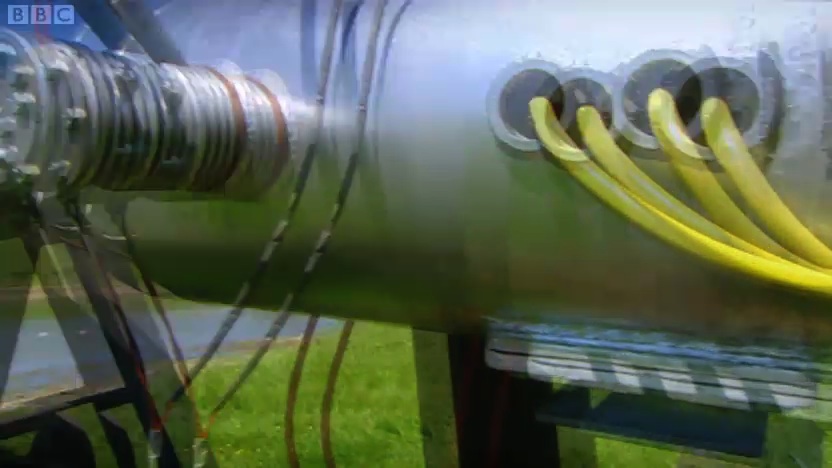
iPlayer deinterlacing snafu

The BBC’s iPlayer system manages to deliver remarkably high-quality video over the web, but it’s not flawless. Most of the problems I’ve seen, like this one, seem to revolve around interlaced video. Specifically, the way it’s deinterlaced.

This is a straightforward transcoding goof – the fields should have been deinterlaced to one set of frames, not… er… four – but I’ve also seen some pretty ghastly field inversion issues – where successive frames on iPlayer have ping-ponged back-and-forth, so that fast pans and tilts have stuttered terribly. Most notably, the high-res iPlayer version of one of Stephen Fry’s Last Chance to See programmes was unwatchable. Not merely ‘broadcast-wonk-turning-his-nose-up’ unwatchable, but ‘oh-hell-I-feel-ill’ unwatchable.

It’s not quite clear to me how this could be happening, in that you’d think the digital masters they’re working from would be in one of a small number of tightly-defined formats. Certainly, BBC technical review is extremely strict, as anyone who’s had a Kafkaesque argument with that department will confirm.

Also, it seems that there’s not much quality control on the finished transcode – or at least, not by anyone who recognises field issues when they see them. The Last Chance to See clip was fixed after a few days, but the programme of Bang Goes The Theory from which this frame is taken is still live, two months later (still is from around timecode 27.43).

Much as I hate to sound like Disgusted of Tynemouth, this is the sort of thing the BBC should get right, every time. They should be humbling the rest of us with their sheer technical prowess.

As it stands, oiks like me shoot everything we intend for the web with progressive frames and proper square pixels, edit and deliver via formats that retains those properties (ProRes and H.264, in my case), and thus never see any problems. It’s the national broadcaster who get tripped up by the details.

Irony.

Producing video

Explaining the difference between a ‘producer’ and a ‘director’ is rather hard, partly because the answer changes depending on the type of film one is making. In movies, the producer is the money guy, while the creative control is held by the director. In factual programmes, however, the director is usually the person literally calling the shots.

The producer, meanwhile, is the one who decides what the story is, and how it’s going to be told. They are at once the budget-holder, project manager, and creative decision-maker.

Thing is, when you’re starting out, and it’s just you with a camera, it’s not obvious what that means. Pointing the camera is camera operation; telling people where to stand and how to move is direction; what else is there?

This article at Pro Video Coalition does a pretty good job of explaining, and it does so in a useful context – that of a promotional film for YouTube, rather than a broadcast documentary. I’m not entirely keen on the finished film, mostly for technical reasons (ironically, it could have done with a director…), but the article is a useful read.

If you’re dipping your toe into web video, and starting to wonder if maybe something’s missing – it is, and that space is called ‘Producer.’